The Top 10 S235 Steel Sheet Pile Manufacturers Worldwide guide begins with a practical question: who can deliver dependable steel, consistent profiles, and project-ready documentation?
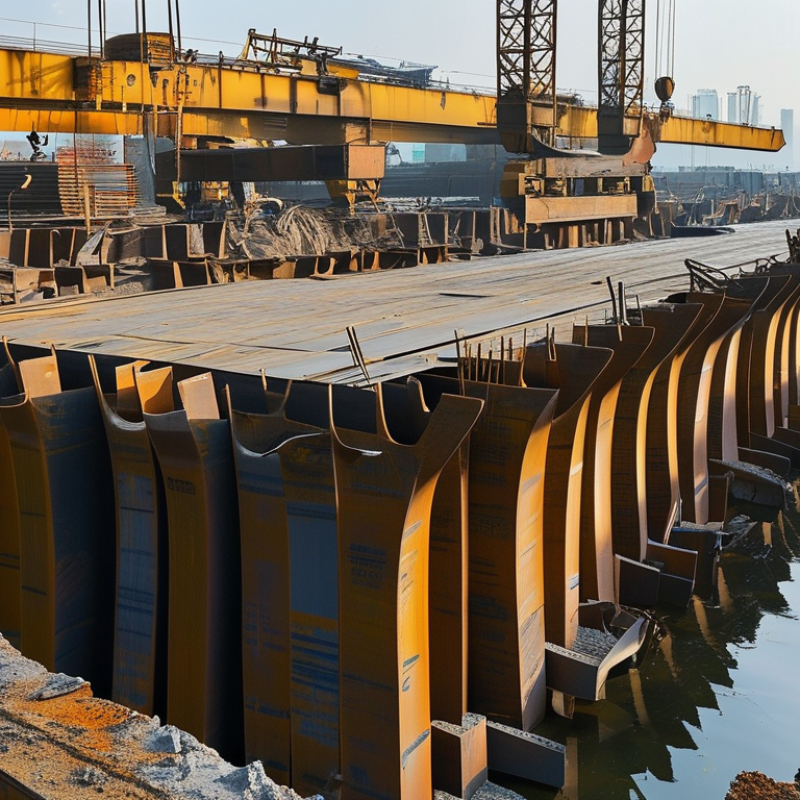
S235 Steel Sheet Pile is widely used for temporary cofferdams, river walls, quay structures, and excavation support. Its European designation indicates a minimum yield strength of 235 MPa under relevant product standards. However, grade alone never proves suitability. Thickness, section modulus, interlock performance, weld quality, corrosion allowance, and installation conditions also matter.
The World Steel Association’s October 2024 Short Range Outlook projected global finished steel demand at approximately 1.75 billion tonnes in 2024 and 1.79 billion tonnes in 2025. That scale highlights the importance of responsible sourcing, yet it does not automatically identify the best sheet pile producer. The OECD Steel Outlook 2024 also warned about continuing global steel overcapacity, making supplier verification more important.
As foundation engineering pioneer Karl Terzaghi stated, “The art of doing foundation engineering consists of designing a foundation which will be safe, and yet economical.” His principle remains relevant here. A manufacturer may offer attractive prices, but real value appears in mill certificates, EN 10248 compliance, dimensional control, traceability, and technical support at the jobsite.
This ranking considers those details. It also examines production capacity, export experience, quality systems, delivery reliability, and engineering assistance. Rankings can change. Some public data remains incomplete. That limitation deserves attention.
A strong supplier should answer practical questions clearly: Can the interlocks survive driving? Are tolerances controlled? Is corrosion protection documented? Can the mill support urgent replacement sections?
These are not minor details. They can determine whether a steel wall stands securely beside a crowded urban excavation.
S235 sheet piles provide a minimum yield strength of 235 MPa for specified thickness ranges. This value indicates when permanent deformation may begin under tensile loading. It does not describe total performance. Profile geometry, steel thickness, interlock quality, and installation conditions also matter. EN 10248-1 defines technical delivery requirements for hot-rolled sheet piles, while EN 10248-2 covers dimensional tolerances. Buyers should request mill certificates, chemical analysis, tensile results, and traceability records. EN 10204 type 3.1 documentation is a practical benchmark for verification.
The World Steel Association reported approximately 1.888 billion tonnes of crude steel production worldwide in 2023. That scale confirms strong manufacturing capacity, but it does not guarantee reliable sheet piles. A large mill can still deliver inconsistent interlocks or poor straightness. During project reviews, I would compare measured dimensions with EN 10248-2, not rely only on catalog values. A wider flange is not automatically a better pile. Soil pressure, driving equipment, corrosion allowance, and water exposure must guide selection. This part is often underestimated.
Tips: Check the declared yield strength against the test certificate. Inspect interlock fit with sample sections before shipment. Confirm length, straightness, and coating requirements in writing. If a supplier avoids batch-level records, pause the purchase. The standard helps, but inspection remains necessary.
A credible Top 10 S235 steel sheet pile ranking should measure more than factory size. Production capacity deserves the highest weight, but figures must refer to sheet piles, not total crude steel. The World Steel Association reported global crude steel production at about 1.89 billion tonnes in 2023. This figure shows market scale, yet it does not prove sheet pile availability. Ranking research should compare annual S235 output, rolling-line capacity, delivery records, and reserve production slots.
Certifications form the second test. S235 products should align with EN 10025-2 and include traceable inspection documents, such as EN 10204 3.1 certificates. ISO 9001 supports process control, while ISO 14001 indicates structured environmental management. Export reach completes the evaluation. UN Comtrade data can reveal shipment frequency, destination diversity, and trade value. Still, customs codes sometimes combine sheet piles with other steel sections. That weakness requires manual verification. A supplier shipping to twenty markets may remain less reliable than one serving five markets consistently.
Tips: Ask for monthly capacity, recent mill certificates, and third-party inspection records. Check whether the stated output covers S235 specifically. Review export data over three years, not one busy season. Factory visits can expose idle lines, incomplete stock, or impressive numbers that need questioning. Past delivery evidence matters. While industry reports improve objectivity, private capacity data is rarely perfect.
This chart presents a transparent editorial weighting model for evaluating S235 steel sheet pile manufacturers without displaying company names or manufacturer-specific data. Production capacity reflects the ability to support large and continuous orders, certifications cover quality, environmental, occupational-safety, and product-compliance evidence, and export reach measures international logistics and market coverage. The technical reference framework includes EN 10025-2 for structural steel grades and EN 10248 for hot-rolled sheet piling.
The top ten S235 steel sheet pile manufacturers worldwide serve ports, flood barriers, basements, bridges, and temporary excavation works. Their product ranges commonly include U-shaped and Z-shaped piles, straight-web sections, corner piles, and connecting elements. Several suppliers offer hot-rolled profiles for demanding foundations, while others focus on lighter cold-formed sections for short-term projects. Available lengths often range from 6 to 24 meters, with different widths, thicknesses, and interlock designs.
A serious comparison should examine more than production volume. The strongest manufacturers provide EN 10248-compliant S235 grades, traceable mill certificates, dimensional inspection, and predictable interlock performance. Some also supply coated piles, welded corners, clutch bars, and engineered accessories. Regional stock matters too. Fast delivery can reduce crane idle time and costly site delays. However, “top ten” rankings are never perfect. Capacity changes, and product ranges differ between factories and distributors.
Tips: Check the required section modulus before choosing a profile. Confirm steel grade, pile length, and interlock tolerances in writing. Ask for recent test documents, not only a catalogue. Review coating thickness when corrosion exposure is high. A small error here can become a large installation problem. Also compare handling weight, because heavier piles may need stronger lifting equipment and more experienced operators.
Top 10 S235 Steel Sheet Pile Manufacturers Worldwide
Technical Comparison: 6–20 mm Thickness, Section Modulus, and Mass per Metre
Comparing S235 sheet piles requires more than reading thickness values. S235 steel typically provides a 235 MPa nominal yield strength, but section geometry controls bending performance. A 6 mm wall may reduce weight, while a 20 mm wall offers greater corrosion allowance and local stiffness. Neither option is automatically better.
For a flat steel strip one metre wide, mass is approximately 47.1 kg at 6 mm thickness, 78.5 kg at 10 mm, 109.9 kg at 14 mm, and 157 kg at 20 mm. Actual sheet pile mass differs because profiles include webs, flanges, and interlocks. Procurement teams should check the declared mass per metre, not estimate it from thickness alone. Small errors become expensive across long retaining walls.
Section modulus deserves closer attention. It measures bending resistance around a chosen axis and depends heavily on profile depth and steel distribution. A deeper 10 mm section can outperform a shallow 14 mm section. On site reviews, I would verify mill certificates, dimensional tolerances, weld quality, and interlock fit before comparing prices. Corrosion exposure also changes the practical choice. Designers should confirm whether the published section modulus is gross or reduced after corrosion allowance. This detail is often missed. A useful comparison table should show thickness, section modulus, mass per metre, steel grade, and test standard together. Otherwise, the ranking may look precise but remain technically incomplete.
Top 10 S235 Steel Sheet Pile Manufacturers Worldwide
When comparing the top 10 S235 steel sheet pile manufacturers, start with measurable tolerances, not attractive catalogs. Check thickness, width, length, straightness, and interlock fit. Ask for the accepted tolerance range in writing. A small deviation can complicate driving, especially in dense soil or repeated interlocking sections. Request a mill certificate, preferably EN 10204 3.1, showing heat number, chemical composition, yield strength, tensile strength, and impact results when specified. Match every certificate to the pile markings. Paperwork without traceability is weak evidence.
Coatings need equal attention. Confirm whether the surface is shot-blasted, primed, galvanized, or protected with an engineered coating system. Ask for dry-film thickness, adhesion results, repair procedures, and inspection records. Coating quality varies. It is easy to overlook damaged edges after bundling. Delivery terms also affect the real purchase price. Clarify Incoterms, loading port, packing method, production lead time, partial shipments, and unloading responsibilities. A low quotation may hide storage or handling costs.
Tips: Keep one approved drawing beside the purchase order. Record tolerances, certificate requirements, coating tests, and delivery dates. Request sample photographs before dispatch. No checklist is perfect. I have seen technically sound orders fail because the shipping window was assumed, not confirmed. Leave room for practical review, especially when site access, crane capacity, or local weather may change the delivery plan.
| Profile | Typical Supply Region | Product Scope | Steel Grade & Standard | Typical Thickness / Length | Dimensional Tolerance Check | Mill Certificate Requirement | Coating Options | Inspection & Traceability | Typical Delivery Terms | Buyer Verification Point |
|---|---|---|---|---|---|---|---|---|---|---|
| Manufacturer Profile 01 | Western Europe | Hot-rolled U and Z sheet piles; interlocking sections; corner and junction piles | S235JR to EN 10025-2; sheet-pile delivery generally referenced to EN 10248-1 | Approx. 6–18 mm; standard mill lengths commonly 6–24 m, subject to transport limits | EN 10248-2 dimensional and shape tolerances; confirm width, height, thickness, straightness and interlock clearance | EN 10204 3.1 Heat number, chemical analysis, mechanical results and product identification required | Uncoated; shop-applied epoxy or polyurethane systems; zinc-rich primer where specified | Heat traceability from billet to finished pile; third-party inspection available by agreement | FCA, FOB, CFR or CIF under Incoterms® 2020; bundled and marked by heat or pack number | Request the approved section drawing and a signed tolerance schedule before production |
| Manufacturer Profile 02 | East Asia | Hot-rolled U-type sheet piles and fabricated accessories for temporary works | S235JR / S235J0 to EN 10025-2; equivalent grades require written approval | Approx. 7–20 mm; common commercial lengths 9–24 m, with cut-to-length service | Confirm EN 10248-2 compliance and interlock rotation, clutch width and pile camber limits | EN 10204 3.1 3.2 inspection can be arranged when required by contract | Mill finish; epoxy, coal-tar-free protective systems or temporary corrosion-prevention coating | Ultrasonic testing of specified welds or repaired areas; packing list linked to heat numbers | FOB or CFR for full cargoes; CIF or DAP may be quoted for smaller project lots | Confirm whether coating thickness is nominal dry-film thickness or total system thickness |
| Manufacturer Profile 03 | North America | Cold-formed and hot-rolled sheet piles; domestic and export project supply | S235-equivalent material must be expressly documented; EN 10025-2 compliance is preferable for S235 orders | Approx. 6–16 mm; typical lengths 6–18 m, subject to forming and handling capability | Use the applicable EN 10248-2 or ASTM project specification; do not assume equivalence without a comparison table | Verify format Require EN 10204 3.1 or an agreed equivalent with heat-level results | Uncoated, galvanized or project-specified paint system; surface preparation grade must be stated | Dimensional report, chemical test and tensile test; independent inspector permitted | EXW, FCA, FOB, CFR or DAP depending on plant and destination | Check whether the quoted section is hot rolled or cold formed, because tolerances and interlock behavior differ |
| Manufacturer Profile 04 | Central Europe | High-volume Z-pile production; threaded bars, walers and corner solutions available | S235JR with minimum nominal yield strength of 235 MPa for relevant thickness range under EN 10025-2 | Approx. 8–25 mm; standard lengths generally 12–24 m, subject to rolling schedule | Measure section modulus, mass per metre, overall width, height and straightness against approved drawings | EN 10204 3.1 Certificate must identify grade, heat, product size and test direction where applicable | Uncoated; ISO 12944 paint systems; cathodic protection or corrosion allowance may be specified separately | Factory production control, calibrated gauges and photographic loading records available on request | FCA plant, CPT project port or DAP site; delivery split by installation sequence can be negotiated | Confirm effective width and theoretical mass, not only nominal pile width, for quantity calculations |
| Manufacturer Profile 05 | South Asia | U-pile and Z-pile sections; welded fabrication and project-specific cutting | S235JR / S235J0 to EN 10025-2; chemical composition limits must appear on the MTC | Approx. 6–22 mm; usual export lengths 6–21 m, with longer lengths subject to shipping approval | EN 10248-2 tolerance review plus inspection of pile end squareness and clutch condition | EN 10204 3.1 Include ladle analysis, tensile properties, impact results where specified and heat traceability | Shop primer, epoxy, polyurethane or duplex systems; coating repair procedure required for handling damage | Pre-shipment inspection, quantity check, marking verification and optional third-party laboratory testing | FOB, CFR or CIF; clarify whether port handling, fumigation and export documentation are included | Ask for a sample coating repair method and minimum acceptable repaired area before shipment |
| Manufacturer Profile 06 | Southeast Asia | Hot-rolled sheet piles for marine, foundation and temporary retaining applications | S235JR to EN 10025-2; alternatives such as ASTM grades should be separately approved | Approx. 7–19 mm; common supply lengths 9–24 m, depending on vessel and port restrictions | Confirm section geometry, straightness, end deformation and interlock tolerances after coating if coated | EN 10204 3.1 Digital PDF plus original or authenticated copy when required by contract | Mill finish; zinc-rich primer, epoxy or polyurethane; hot-dip galvanizing only when section size and standard permit | Marking at both ends or on each bundle; loading plan should identify bundle weight and heat range | CFR/CIF to main ports; DAP or DDP should be priced only after customs and inland transport review | Verify actual bundle weights against vessel limits and lifting equipment capacity |
| Manufacturer Profile 07 | Middle East | Project and stock-based sheet-pile supply; accessories and site delivery coordination | S235JR / S235J0 to EN 10025-2; grade designation must match the purchase order and drawings | Approx. 6–20 mm; stock lengths often 6–18 m, with mill production for longer sections | Require independent dimensional inspection because stock material may have been handled or previously stored | Confirm original MTC Certificates must be linked to visible heat markings and bundle identification | Uncoated or field-applied protective coating; specify surface preparation, primer type and DFT | Visual inspection, dimensional survey and certificate review; NDT scope should be stated in the ITP | EXW, FCA, CPT or DAP; storage period and demurrage responsibility must be written into the offer | Check storage conditions, rust scale, clutch damage and remaining coating life for stock material |
| Manufacturer Profile 08 | Eastern Europe | Hot-rolled U and Z profiles; long-length production and rail or barge logistics | S235JR under EN 10025-2 with sheet-pile requirements under EN 10248-1 | Approx. 8–24 mm; lengths commonly 12–30 m when transport permits | Check EN 10248-2 limits plus straightness over full length and permissible end trimming tolerance | EN 10204 3.1 3.2 inspection may be included for infrastructure and marine projects | Uncoated or ISO 12944 C3–C5 coating system selected according to exposure category | ITP, calibration certificates, batch photographs and loading inspection available by contract | FCA, CPT, DAP or rail-delivered terms; define unloading point and crane responsibility | Review the proposed transport method for bending risk and confirm maximum bundle length |
| Manufacturer Profile 09 | Latin America | Regional and export supply of U-type piles; cutting, drilling and fabricated steel accessories | S235JR to EN 10025-2 or documented equivalent accepted by the engineer | Approx. 6–18 mm; standard lengths commonly 6–18 m, with project cutting available | Confirm mass tolerance, section width, profile height, clutch alignment and residual camber | EN 10204 3.1 Require bilingual certificate format if required for customs or project records | Mill finish; epoxy, polyurethane or zinc-rich systems; coating compatibility with welding must be documented | Batch identification, tensile testing and optional independent inspection before dispatch | FCA, FOB, CFR or CIF; include port storage, export packing and marine insurance responsibilities | Confirm whether cut lengths are supplied with factory-sealed ends and corrosion protection |
| Manufacturer Profile 10 | Oceania and export markets | Special-purpose sheet piles for marine works, temporary cofferdams and reusable systems | S235JR to EN 10025-2; durability design may require a corrosion allowance beyond the steel grade | Approx. 7–21 mm; typical lengths 9–24 m, subject to local lifting, road and port regulations | Require dimensional report at mill exit and confirmation that interlocks remain functional after transport | EN 10204 3.1 Certificate package should include MTCs, packing list, inspection release and nonconformance statement | Uncoated, marine epoxy, polyurethane or duplex coating; specify ISO 8501-1 preparation and DFT acceptance | Hold-point inspection, coating DFT readings and traceable nonconformance closeout | FOB, CFR, CIF, DAP or project-specific delivered-duty terms under Incoterms® 2020 | For marine exposure, verify coating specification, corrosion allowance, weld repair procedure and installation method |

Core buyer checks: Confirm that S235 means the required EN 10025-2 grade, that sheet-pile geometry and tolerances are documented to the applicable project standard, and that every bundle can be traced to an EN 10204 3.1 mill certificate. For coated piles, request surface-preparation grade, coating manufacturer-independent performance requirements, dry-film-thickness readings and a repair procedure. Delivery quotations should identify the selected Incoterms® 2020 rule, loading port, destination, insurance, unloading, customs clearance and responsibility for demurrage.