


7 Tractor Hydraulic Ram Buying Tips for Global Buyers

Global agricultural production is changing, and machinery must work across varied crops, climates, and service conditions. The OECD-FAO Agricultural Outlook 2024–2033 projects global agricultural and fish production to grow 14% by 2033, compared with the 2021–2023 baseline. That is a production forecast, not a hydraulic-cylinder sales forecast. Still, it signals why dependable equipment matters.

FAOSTAT’s agricultural machinery data offer another useful lens: tractor availability differs between countries. For global buyers, that variation makes a one-size-fits-all purchase risky. A Tractor Hydraulic Ram may look suitable in a catalog, yet perform poorly if its stroke, mounting points, pressure rating, or seal materials do not match the machine and operating conditions. Small details bite. Ask suppliers for dimensional drawings, rated operating pressure, material specifications, and test documentation. Check whether replacement seals are accessible locally, too.

This guide presents seven practical buying tips, from matching ram geometry to checking supplier quality and after-sales support. It focuses on verifiable specifications rather than broad promises. A low price can be tempting. But freight, downtime, and an unavailable seal kit may outweigh the initial saving. Specifications can still leave questions; confirm fit and operating requirements with a qualified technician before ordering. That extra check is easy to skip—and worth reconsidering.
7 Tractor Hydraulic Ram Buying Tips for Global Buyers

Define the Tractor’s Hydraulic Ram Requirements

Before selecting a tractor hydraulic ram, define the job it must perform. Note the implement, expected load, and how often the ram will cycle. A loader lift and a rear attachment may need very different stroke lengths and mounting arrangements. Measure the available space with the tractor parked safely, including pin-to-pin distance when retracted and extended. Measure twice.

Next, check the tractor’s hydraulic system. Record its operating pressure and available flow from the manual or a qualified service professional. These figures help confirm whether the ram can deliver suitable force and speed. Decide whether the application needs a single-acting or double-acting cylinder. Also identify the hose connections, port position, and required pin diameter. Small details matter. A fitting that nearly matches can still cause leaks or installation problems.

Consider working conditions, not just dimensions. Mud, dust, cold starts, and long periods under load can affect seal life and performance. Specify the expected duty cycle and ask about compatible seal materials and maintenance intervals. If replacing an existing ram, compare its bore, rod diameter, stroke, and closed length rather than relying on appearance. That shortcut is tempting, but it can miss a critical difference. I would recheck measurements against the tractor and implement before ordering, especially when the original cylinder has already been modified.

Choose a Ram Type That Matches the Intended Application

Choose a ram by the job it must perform, not by appearance. A loader lift, a three-point hitch, and a tipping trailer place different loads and side forces on the cylinder. ASABE’s D497.7 Agricultural Machinery Management Data provides implement draft estimates that vary with soil, working depth, and speed. Use those estimates to understand likely operating loads, then check the tractor’s hydraulic pressure and flow against the ram’s rated limits. Soil changes. So does the load.

For lifting, confirm the required force across the full stroke, especially near the point where the linkage gives the ram the least mechanical advantage. For tipping, check the trailer’s loaded weight, pivot position, and cylinder mounting angle; a shallow starting angle can demand much greater force. Match the stroke to the actual movement, too. A longer ram is not automatically better. It may bind against the frame or expose more rod than the job requires. ISO 4413 hydraulic-fluid-power guidance also emphasizes safe system design and pressure control, so include suitable protection rather than relying on careful operation alone.

Tips: Record the implement load, stroke, mounting points, and tractor pressure before ordering. Compare the figures with ASABE draft data where relevant, and verify them on the machine. A rough measurement can mislead; recheck the geometry with the implement raised and lowered.

7 Tractor Hydraulic Ram Buying Tips for Global Buyers - Choose a Ram Type That Matches the Intended Application

Tip Application or requirement Ram type or feature to consider What to check before ordering
1. Match the action to the task A tipper body or other load that is raised hydraulically and lowered by gravity Single-acting cylinder Confirm that the load and mechanism can safely return the cylinder. A single-acting cylinder is powered in one direction; the return is not hydraulically driven.
2. Choose powered movement in both directions when needed Implements that need controlled extension and retraction, such as adjustable linkages or loader functions Double-acting cylinder Check that the tractor valve and hydraulic circuit can supply and return oil through both ports. Retraction force is lower than extension force for the same pressure because the rod reduces the effective area.
3. Consider a telescopic design for long travel in limited space Applications such as raising a tipping body where a long stroke is needed but the retracted cylinder must remain relatively short Telescopic cylinder, commonly single-acting for gravity-return applications Compare the required stroke, retracted length, mounting geometry, stage sequence, and load stability. Stage-by-stage force and speed can differ.
4. Match the construction to service conditions Equipment exposed to dirt, vibration, frequent use, or limited maintenance access Welded-body cylinder for a compact package, or tie-rod construction where its design and service requirements suit the installation Compare pressure rating, sealing, corrosion protection, mounting style, and available service parts. Construction type alone does not determine suitability; confirm the cylinder is rated for the circuit and duty.
5. Verify bore, rod diameter, and required force Lifting, pushing, or holding a specified load through the implement’s linkage Cylinder sized for the required force and working pressure For extension, theoretical force is pressure multiplied by piston area. For retraction, use the annular area (piston area minus rod area). Account for linkage geometry, friction, and the implement load; do not exceed system ratings.
6. Measure the complete fit, not just the stroke Replacing a cylinder or fitting one to an existing tractor or implement Cylinder with matching mounting and port configuration Record retracted and extended pin-to-pin lengths, stroke, pin diameter, mount width, port thread and location, and hose clearance. Confirm that the cylinder will not bottom out before the implement reaches its mechanical limit.
7. Check pressure, flow, and operating environment Tractors used across different climates, work cycles, and hydraulic-system configurations Cylinder and seals specified for the system’s pressure, fluid, temperature, and duty Compare the cylinder’s rated pressure with the tractor circuit, verify fluid and seal compatibility, and check temperature range and corrosion protection. Hydraulic flow affects operating speed; pressure and cylinder area determine theoretical force.

Check Dimensions, Pressure Ratings, and Tractor Compatibility

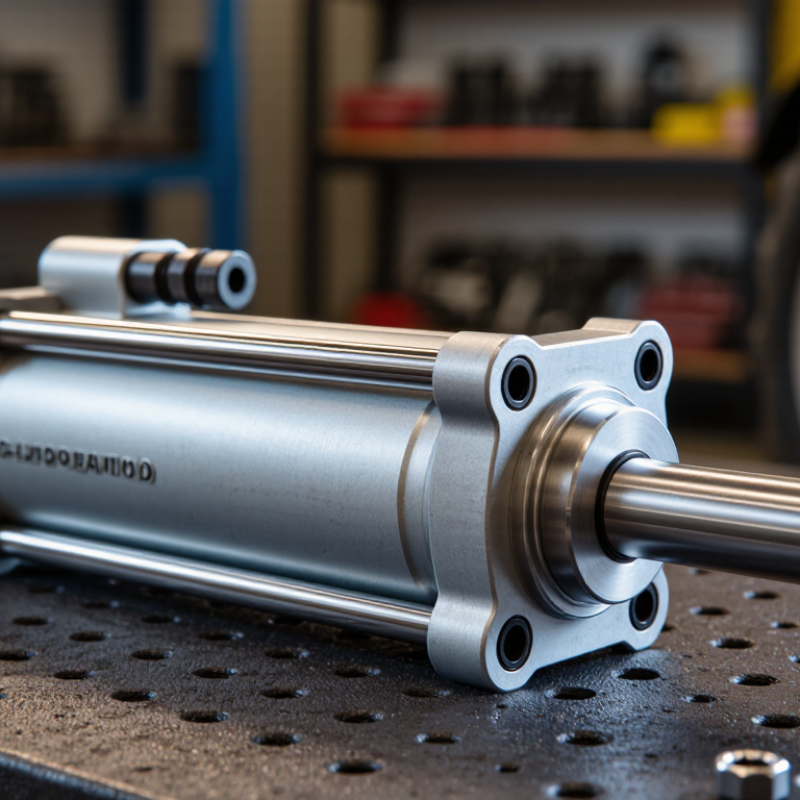
A tractor hydraulic ram can look suitable on a workbench and still fail to fit the machine. Measure the mounting-pin diameter, lug width, and distance between pin centers with the ram fully retracted. Then compare the required stroke with the space available at full extension. Measure twice. A small mismatch can bind the linkage or prevent an implement from reaching its working position.

Pressure ratings need equal care. Check the tractor’s hydraulic system pressure in its manual, then choose a cylinder rated for that operating pressure. The system relief setting should not exceed the rating of the ram, hoses, or fittings. Cylinder bore also affects lifting force: a larger bore produces more force at the same pressure, but may change response and load on the machine. Do not assume that a heavier-looking cylinder is automatically safer.

Compatibility includes more than pressure and dimensions. Confirm the port thread and hose connection, pin style, mounting angle, and clearance around the rod and barrel. Check whether the tractor uses the valve arrangement the cylinder requires. Flow mainly affects movement speed. In practice, measurements can be awkward when an old ram is bent or partly seized, so record each dimension and verify uncertain values against the tractor documentation. A careful check now is less frustrating than discovering a fit problem in the field.

Tractor Hydraulic Ram Buying Guide: Bore Size and Theoretical Force

The bars show calculated extension force for example nominal bore diameters at a fixed pressure of 17.2 MPa (approximately 2,500 psi). Actual force may differ, and a larger bore does not guarantee compatibility. Before buying, check your tractor’s hydraulic pressure and flow specifications, plus the ram’s stroke, pin dimensions, and retracted length.

Assess Materials, Manufacturing Quality, and Required Certifications

7 Tractor Hydraulic Ram Buying Tips for Global Buyers

A tractor hydraulic ram works under pressure, vibration, and weather exposure, so material details matter. Ask for the cylinder-tube grade, piston-rod surface treatment, seal compound, and corrosion-protection specification. A polished rod should feel smooth, with no pits or plating blisters; even small surface defects can damage seals. Request material certificates and batch traceability, not just a general claim of “high-strength steel.” These records help confirm that delivered parts match the quoted specification.

Manufacturing quality is visible in less obvious details. Check weld consistency, bore finish, rod straightness, and pressure-test records. ISO 4406:2021 classifies hydraulic-fluid contamination by particle counts at 4, 6, and 14 micrometres. For example, code 18 at 4 micrometres represents 1,300–2,500 particles per millilitre. This is a cleanliness classification, not a universal ram acceptance limit; confirm the target with the tractor system specification. Small details matter.

For certification, verify the certificate issuer, validity dates, and exact factory scope. ISO 9001 covers a quality-management system; it does not certify a specific hydraulic ram’s performance. Ask for test procedures, inspection reports, and applicable market conformity documents. Requirements vary by destination and machine type, so have the importer confirm them before shipment. One caveat: paperwork can look complete while omitting the actual production site. Check it carefully.

Compare Suppliers, Warranty Terms, Shipping, and Total Cost

When sourcing a tractor hydraulic ram internationally, compare suppliers on more than the quoted price. Request drawings, bore and rod dimensions, stroke length, port details, and operating-pressure ratings. Ask how each supplier checks seals and tests for leakage before dispatch. Clear answers are useful. Vague specifications can lead to a ram that fits poorly or performs differently than expected.

Read warranty terms before placing an order. Check what is covered, how long coverage lasts, and who pays for replacement shipping or inspection. Ask whether damage from installation or contamination is excluded. A warranty may look generous, yet be difficult to use if the claim process is unclear. Keep the written offer and technical documents together; small details are easy to forget.

Shipping can change the real cost substantially. Compare crate dimensions, packing methods, estimated transit time, and delivery terms. Confirm whether the quote includes freight, insurance, customs charges, and delivery to your site. Then calculate the total cost, not just the unit price. A cheaper ram may require expensive freight or extra fittings. Spreadsheets help, but they can miss local handling fees, so leave room for unexpected charges. Check the delivery address and unloading arrangements before the crate arrives.