


Why Choose a Pallet Conveyor for Your Warehouse?
A pallet conveyor can turn scattered warehouse movements into a measured, repeatable flow. It moves heavy loads between receiving, storage, picking, and shipping areas with fewer manual transfers. Picture a loaded pallet leaving a dock and arriving at a rack without repeated forklift handling. That consistency can reduce congestion, product damage, and unnecessary travel.
Industry data supports this direction. MHI’s 2023 Annual Industry Report stated that 83% of supply chain professionals planned to adopt robotics and automation within five years. The report also highlighted continuing workforce challenges across logistics operations. A Pallet Conveyor cannot solve every labor or layout problem. It can, however, give employees a safer and more predictable material-handling route. The U.S. Bureau of Labor Statistics continues to identify transportation and material-moving work as a large employment category, showing the scale of daily handling demands. Small gains matter.
Professional experience suggests that successful conveyor projects begin with details, not equipment catalogs. Engineers must review pallet weight, dimensions, throughput, accumulation needs, floor space, and safety access. A system designed for standard pallets may struggle with damaged boards or uneven loads. That weakness deserves attention. Energy use, maintenance access, sensor placement, and future expansion also affect the real return on investment. A well-selected Pallet Conveyor supports smoother operations, but poor planning can simply automate an inefficient process. This article examines the practical reasons warehouses choose pallet conveyors and the limitations decision-makers should consider.
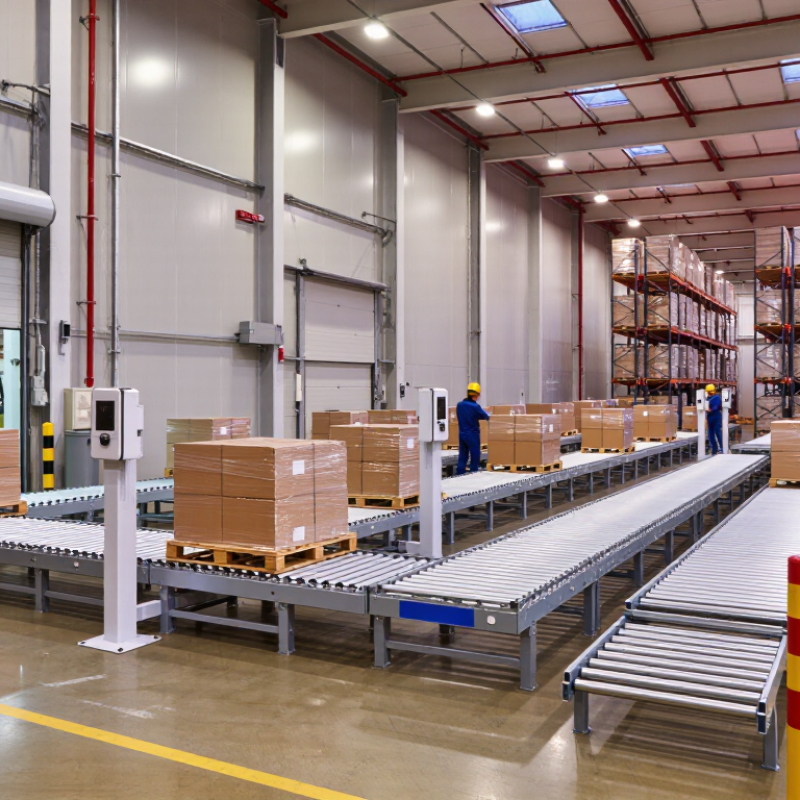
A pallet conveyor is a powered or gravity-driven system that moves palletized loads through a warehouse. Rollers support the pallet, while motors, chains, sensors, and controls guide its movement. A typical line may carry a pallet from receiving to storage, picking, staging, or shipping without repeated forklift handling.
The operating sequence is practical. A sensor detects the pallet, then starts or stops a conveyor zone. Controls maintain spacing and prevent collisions. Roller conveyors suit standard pallets with firm, even bases. Chain conveyors handle heavier or less stable loads. Transfers can turn, merge, lift, or redirect pallets between lines. The process resembles traffic management on a factory floor. Quiet, but highly structured.
Automation demand is rising. The 2024 MHI Annual Industry Report found that 55% of supply chain leaders expected to adopt artificial intelligence within one or two years. The report also identifies robotics and automation as major investment priorities. OSHA guidance stresses guarding, lockout procedures, and safe separation around moving equipment. These details matter during installation and daily use. A conveyor designed only for speed may create jams, damaged goods, or difficult maintenance access. In real warehouses, pallet dimensions vary, floors settle, and sensors get dusty. That is where planning becomes less perfect. Operators should test actual loads, not rely only on catalog figures. Performance depends on pallet quality, routing logic, load weight, and maintenance discipline.
Why Choose a Pallet Conveyor for Your Warehouse?
Key Warehouse Challenges Pallet Conveyors Can Address
Warehouse teams often struggle with slow pallet movement between receiving, storage, picking, and shipping. Forklifts may handle these transfers, but repeated travel creates congestion, noise, and avoidable collision risks. Pallet conveyors create a defined route for heavy loads. They can reduce unnecessary driving and keep operators focused on tasks requiring judgment. Queues grow fast.
In warehouse assessments, I have seen a single poorly placed transfer point delay an entire shipping lane. A conveyor system can connect work zones, maintain a steadier flow, and support better labor planning. Accumulation sections can hold pallets temporarily when the next station is occupied. Sensors also provide useful movement data, although they still require correct setup and regular testing. Small details matter.
The right design depends on pallet dimensions, load weight, floor conditions, and required throughput. Safety guarding, emergency stops, access gates, and maintenance clearance should be planned before installation. A conveyor will not fix inaccurate inventory data or weak operating procedures. That assumption fails. Damaged pallets may still stop the line, and unusual loads may need manual handling. Experienced teams should review real operating patterns, not only ideal production figures. This practical review helps prevent expensive changes after installation.
| Warehouse Challenge | Typical Operational Effect | How a Pallet Conveyor Helps | Relevant Conveyor Type or Feature | Indicative Performance Consideration |
|---|---|---|---|---|
| Long travel distances between storage, picking, and shipping areas | Forklifts or pallet trucks spend time moving loads instead of supporting productive warehouse tasks. | Creates a fixed, repeatable route for pallet movement and reduces unnecessary vehicle travel. | Powered roller conveyor, chain conveyor, transfers, and accumulation zones. | Best suited to frequent, predictable pallet flows between defined points. |
| Warehouse congestion at receiving and dispatch docks | Pallets can queue in travel aisles, obstruct dock access, and increase loading or unloading delays. | Moves pallets through controlled lanes and provides temporary accumulation without blocking main traffic routes. | Accumulation conveyor, zero-pressure logic, merge sections, and dock staging lanes. | System capacity should be matched to dock door throughput and trailer appointment patterns. |
| High labor demand for repetitive pallet handling | Operators repeatedly drive, stop, position, and collect pallets during routine transport tasks. | Automates repetitive horizontal movement so employees can focus on picking, replenishment, quality checks, or loading. | Motor-driven roller conveyor with sensors, controls, and automated routing. | Labor savings depend on travel distance, shift pattern, pallet volume, and system integration. |
| Inconsistent pallet flow and manual handoff errors | Pallets may be sent to the wrong lane, delayed at handoff points, or positioned incorrectly for the next process. | Uses sensors, programmable controls, barcode or RFID integration, and predefined routing rules. | Sortation conveyor, automatic transfer car interface, barcode scanning, and PLC controls. | Accuracy improves when pallet identification and routing data are maintained consistently. |
| Forklift traffic and workplace safety exposure | Mixed pedestrian and vehicle traffic can create collision risks, blind spots, and restricted visibility. | Separates recurring pallet transport from pedestrian work areas and reduces vehicle movements on selected routes. | Guarded conveyor sections, safety fencing, emergency stops, warning lights, and interlocked gates. | A conveyor does not remove all risks; site risk assessment, guarding, training, and traffic planning remain essential. |
| Limited visibility of pallet location and status | Supervisors may rely on manual checks to determine whether a pallet is waiting, moving, blocked, or ready for dispatch. | Provides sensor feedback and event data that can be connected to warehouse control or management systems. | Photoelectric sensors, pallet presence detection, dashboard monitoring, and system alarms. | Useful metrics include queue time, blocked time, throughput, and pallet dwell time. |
| Demand for scalable throughput | Manual transport capacity can become difficult to expand during seasonal peaks or business growth. | Allows additional conveyor zones, lanes, accumulation, and control points to be added as process requirements grow. | Modular conveyor sections, adjustable controls, additional induction points, and expandable sortation. | Design should consider peak hourly volume rather than average daily volume alone. |
| Product damage caused by repeated manual handling | Uncontrolled stops, impacts, or incorrect pallet positioning can contribute to load instability and packaging damage. | Provides controlled acceleration, deceleration, transfers, and pallet positioning at defined process points. | Low-impact transfers, pallet stops, guide rails, and controlled accumulation. | Load quality still depends on pallet condition, wrapping, weight distribution, and correct conveyor specifications. |
| Need to connect storage and warehouse processes | Receiving, storage, picking, staging, and shipping may operate as separate activities with delays between them. | Creates a material-flow link between workstations and supports coordinated movement across the warehouse. | Straight conveyors, curves, lifts, transfers, pallet dispensers, and warehouse software interfaces. | Layout design should account for pallet dimensions, load weight, aisle width, floor conditions, and maintenance access. |
| Rising energy and operating costs | Vehicle fuel or charging, labor, maintenance, and unproductive travel add to the cost per pallet moved. | Uses fixed-path transport and can operate with zone control so only required sections run when pallets are present. | Energy-efficient motors, sensor-controlled zones, variable-speed drives, and sleep modes. | Total cost should include electricity, maintenance, spare parts, downtime, and expected utilization. |
Note: Actual throughput, capacity, labor impact, and return on investment vary according to pallet size and weight, conveyor layout, operating hours, product mix, controls, and warehouse process design.
Why Choose a Pallet Conveyor for Your Warehouse?
Main Types of Pallet Conveyors and Their Applications
Pallet conveyors move heavy loads with less manual handling and more predictable flow. Gravity roller conveyors suit short distances and steady floor-level transfers. They use pallet weight and slope, so energy use stays low. However, poor pallet quality can cause stopping and uneven movement. This detail is often underestimated.
Powered roller conveyors handle longer routes, frequent transfers, and controlled accumulation. Sensors can pause pallets before packing, storage, or dispatch areas. They work well when operators need consistent spacing. Chain conveyors are stronger for damaged pallets, cross-transfer points, and heavier loads. Their direct contact supports stable movement, even when pallet bottoms are uneven. Belt conveyors can carry smaller packaged goods, but they are not always ideal for heavy pallets.
Tips: Check pallet dimensions, load weight, and bottom-board condition before selecting equipment. Leave service access near motors, sensors, and transfer units. Test the conveyor with real pallets, not only perfect samples. A layout may look efficient on paper but create awkward walking paths. Include emergency stops and guarded moving parts. Review noise, speed, and cleaning needs during daily operation. Small design changes matter. I have found that accumulation zones need more space than expected, especially during busy shifts. A slower conveyor may sometimes protect products better than a faster one.
Pallet conveyors support faster, steadier warehouse operations.
They move heavy loads along fixed routes, reducing manual pushing and unnecessary forklift travel.
The benefits become visible during busy shifts. Pallets arrive at the same height, helping workers load, scan, and transfer goods with fewer awkward movements.
MHI’s 2024 Annual Industry Report shows that supply chain organizations continue increasing investment in automation and material-handling technology. That trend reflects real pressure: labor shortages, tighter delivery windows, and rising order volumes.
A well-designed system also improves inventory flow. Sensors can pause a pallet before a blocked zone, while controls record movement between storage and shipping.
Useful data, not magic. Poor layouts still create delays, and conveyors require inspections, guarding, and preventive maintenance.
In my experience, the best results come from measuring travel distance, peak pallet volume, and loading errors before installation. Guesswork is expensive. A smaller conveyor may outperform a larger one when the route and controls fit the warehouse.
Choosing a pallet conveyor starts with observing daily warehouse work. Measure pallet weight, length, width, and bottom condition. Record peak loads, not average loads. A conveyor handling 40 pallets per hour may struggle during seasonal surges. Leave room for unexpected growth. That detail is often missed.
Match the conveyor type to your movement pattern. Roller conveyors suit stable pallets and straight transfer routes. Chain conveyors can manage uneven pallet bottoms and heavier loads. Include accumulation zones near docks, picking areas, and wrapping stations. Confirm the available floor space before selecting equipment. A paper layout can hide real obstacles.
Inspect the facility environment carefully. Dust, moisture, temperature changes, and washdown routines affect component choices. Ask operators where jams usually occur. Their practical knowledge may reveal problems that drawings miss. Check emergency stops, guarding, access points, and noise levels. Safety must guide the design, not follow it.
Review controls and maintenance requirements with qualified technicians. The system should connect clearly with scanners, warehouse software, and existing equipment. Request load testing and documented performance data before installation. Reliability depends on alignment, lubrication, sensor placement, and operator training. Even a well-planned conveyor can need adjustment after launch. That is normal. Regular inspections protect throughput and reduce avoidable downtime.